

In this episode of From Fact to Fiction, I talk with screenwriter and debut novelist Michael Lucker about Rule One, a suspense thriller rooted in his own long and frustrating medical mystery.
We discuss how more than forty doctors, years of cross-country searching, and a mix of traditional, alternative, and spiritual approaches shaped the novel’s central premise:
What happens when a disturbed and desperate patient decides his doctors must experience his pain for themselves?
WATCH here or on YouTube.
LISTEN on From Fact To Fiction: Thrilling Book Reviews Podcast
READ the transcript below, edited for length and clarity
BUY Rule One.
And, if you are enjoying From Fact To Fiction, please let me know. Add a comment, like this post, or send me a note.
Introduction
Linda
Thank you, everyone, for joining us today on From Fact to Fiction, where we unpack the truth behind my favorite specialty thrillers, from medical to espionage to techno-thrillers.
And the best of these blend fact with fiction so well, you don’t know what is, what could be, and what’s totally impossible. It would take an expert to know.
That’s why each week I pair up with an expert and we select a new specialty thriller. We’ll not only talk about why we love the book, but also unpack the truth behind the fiction.
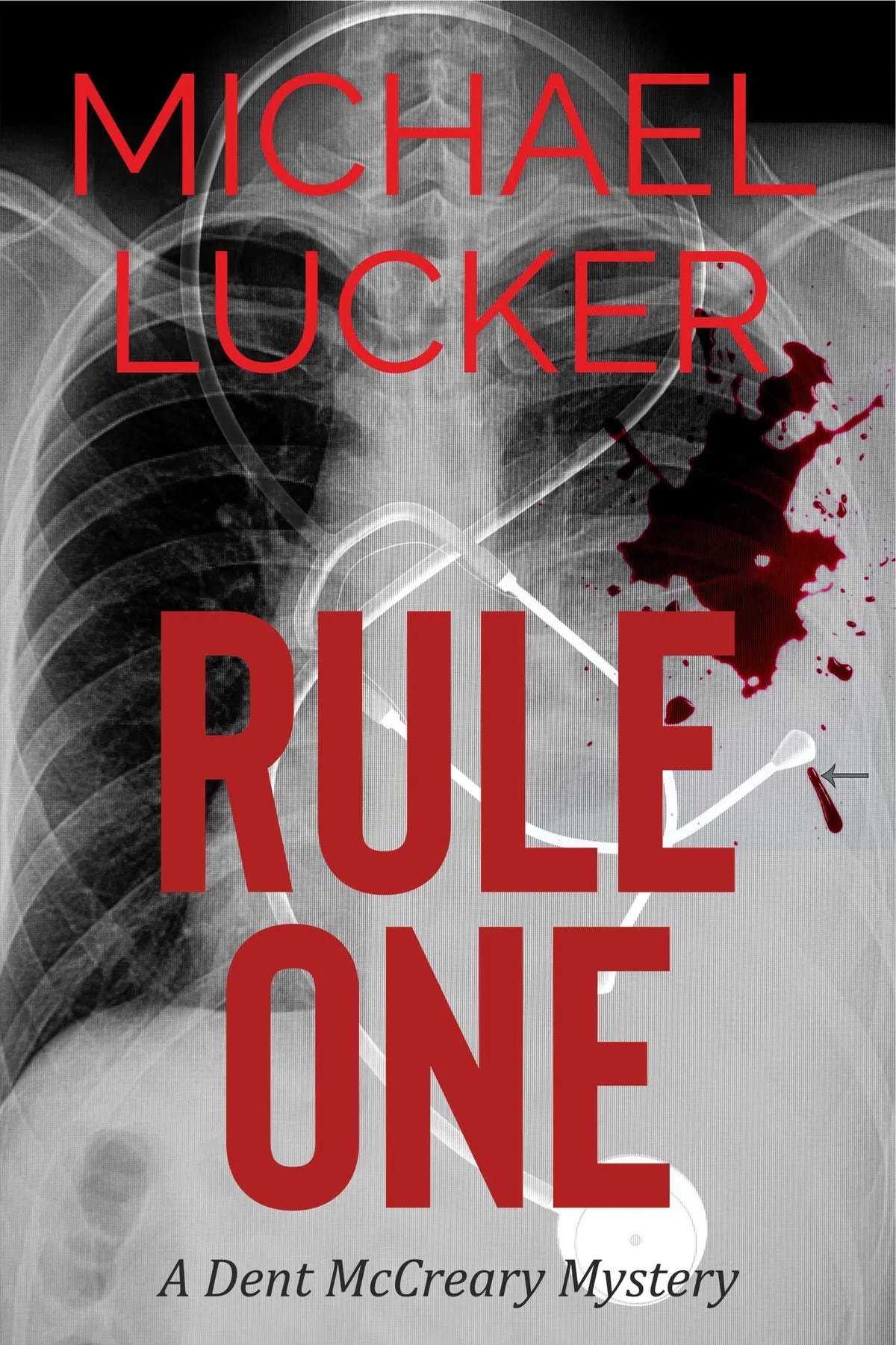
Today our book is the 2026 suspense thriller Rule One by Michael Lucker. It’s a finalist for a Silver Falchion Award, which is a prestigious award for our non-writers out there. I listened to the audiobook, and it is just terrific.
Our guest today is both our author and our expert. Michael, welcome.
Michael
Thank you. Thanks for having me.
Linda
Ever been to a doctor who didn’t listen? Who didn’t care? Who didn’t help?
Ever wish you could change places with them—to have them experience your pain firsthand? Maybe if they knew how you felt, they’d take you seriously.
Rule One is a thriller to teach those doctors a lesson.
What do you think? Did I get it?
Michael
You encapsulated it so well, maybe you should be my agent.
Linda
Michael has been writing songs, articles, and plays since the fourth grade. After graduating from Boston University, he and his Mercury Capri hit the road for LA, where he landed a job as an assistant to Steven Spielberg before embarking on a career writing movies for a plethora of film studios—Disney, DreamWorks, Paramount, Fox, and Universal.
He went on to work in television, creating series and teaching screenwriting at universities. His book on screenwriting, Crash! Boom! Bang! How to Write Action Movies, is available wherever books are sold.
But Rule One is his debut novel, a suspenseful mystery thriller inspired by a long-unsolved medical mystery.
Finding the Voice of Rule One
Linda
But before we get to the facts behind the fiction, Michael, I want to ask you about something that really struck me.
You have a unique voice in this novel. Where did you find it, and what authors inspired you?
Michael
Wow. First of all, I appreciate that you zoomed in on the voice of the narrator.
It’s my snarky, cynical wit coming through. I think it was born out of my youth, my college years in Boston, and slinging it out on the streets of Los Angeles and wherever else I’ve been.
In terms of authors who inspired me, I’d like to say it comes from some of the greats, but I grew up on television and movies. A lot of my wit and sensibility comes from Bruce Willis, Mel Gibson, Eddie Murphy, and those iconic movie stars I grew up on—and, of course, the screenwriters behind them.
Whether it was Daniel Petrie Jr., Aaron Sorkin, Steve Zaillian, Shane Black, or Cash and Epps.
Once I got to college and discovered I could actually write movies for a living, I started reading screenplays.
So between reading screenplays, reading books about writing screenplays, and watching movies, that’s really how my authorial voice was born.
Linda
When I read—or actually read and listened to—Rule One, the main protagonist, FBI profiler Dent McCready, reminded me of Michael Connelly’s Bosch. I saw that same heart, integrity, and insubordination.
But because the book is written from multiple points of view, there’s also this narrator with a sarcastic, snarky wit. To me, that narrator almost becomes a character carrying through everything.
Your book description mentions Elmore Leonard, and I could see that. But I’m going to tell you who Rule One really reminded me of: Carl Hiaasen.
Michael
That is one of my favorite authors. The fact that you picked up on that is so flattering.
And maybe we can talk about this downstream, but I’m developing Rule One into a television series now with one of the producers from Bosch.
Linda
Well, apparently it’s seeping through!
The Real Medical Mystery Behind Rule One
Linda
Let’s get to the facts behind the fiction. We have to talk about the main plot.
We have an FBI profiler chasing a serial killer, and it comes out that the killer is targeting some of his many doctors—the doctors who couldn’t help him identify or resolve his medical condition.
Earlier, I said Rule One was inspired by a long-unsolved medical mystery. I just didn’t say it was your mystery.
Can you tell us a little about the real-life experience that inspired the book?
Michael
Sure. I can tell you about it, but you just read about it, because much of the book is my story.
A lot of people encouraged me to share my story to help others, but I didn’t want to write a biographical story about a guy who got sick and his triumph in getting well. That wasn’t very appealing to me.
But setting it in the world of a thriller sounded really appealing.
I was a successful screenwriter in Los Angeles when I started getting sick. All these symptoms began hitting me—brain fog, shortness of breath, low-grade fever, malaise, and a variety of other symptoms that I won’t put everybody through here.
I started going to doctor after doctor, not only in Los Angeles, but eventually seeking healthcare outside of LA and seeing specialists in different cities around the country.
I went on this whole odyssey trying to find homeostasis—trying to find wellness.
Eventually, I found doctors who figured out what was going on and were able to get me well.
But while I was going through it, I always wished that all the doctors and healthcare practitioners I was seeing knew what it felt like to be me when I came through their doors.
Then I realized I’m not the only one.
All of us—whether it’s ourselves, our children, our parents, or our friends—go to doctors hoping they’ll have the answers to make us better. Oftentimes, they don’t.
When they make a valiant effort, that’s appreciated and valued. But sometimes they were too busy to do the due diligence—to get to the next patient, the back nine on the golf course, or a cocktail party.
I found that crushing when I was sick.
So that was really my inspiration. I wanted to make those doctors I’d seen know what it felt like to be us.
That was the general impetus for writing the story.
Linda
I think you succeeded.
In the book, the killer tries almost every kind of doctor—GPs, ENTs, specialists, and even medicine that we’d consider unorthodox from a Western standpoint.
I guess your real-life experience mirrored that. You went to many different kinds of practitioners.
Michael
Absolutely.
I saw Eastern doctors, Western doctors, traditional doctors, surgeons, specialists, infectious disease doctors.
Then I saw a Reiki specialist. I did acupuncture. I tried holistic and homeopathic remedies and all kinds of tinctures and formulas that were concocted for me or that I was directed toward.
Some of them made me feel worse.
And that’s really what I wanted healthcare practitioners to understand. We may come in with certain symptoms, but after we’re under someone’s care for a while, sometimes we leave with others.
It’s difficult when you’re trying to find a remedy and you don’t have homeostasis—any balance.
If you’re feeling well and suddenly get dizzy, you know, I’m feeling dizzy.
But if you’re already dizzy, then develop a low-grade fever, then shortness of breath, then feel like you’re being eaten alive from within—and that’s your day-to-day norm—it’s difficult to tell what’s changing.
You don’t have a control group, if you will.
That’s what I was after in my own pursuit: trying to feel normal and ultimately finding somebody who could solve it.
In the end, I think the reason I’m healthy now is because I pursued health on three different legs of the stool.
You need traditional medicine. In my case, I also needed alternative medicine. And I think you need some spiritual medicine in terms of having an understanding or foundation and belief in something larger than us.
If you’re trying to heal from a chronic illness, I think you need to pursue all three: traditional, alternative, and spiritual.
A lot of people pour all their time, energy, and money into one leg of the stool. I think they’re going to have a tougher time getting well.
What Do You Do When No One Has an Answer?
Linda
I think you just answered a question I was going to ask.
What would you say to someone experiencing similar frustrations with an undiagnosed or misdiagnosed health issue?
Michael
Don’t stop looking.
Don’t stop searching for answers.
I was so sick for so long that I just wanted an answer, no matter what it was.
If they’d told me I had cancer, HIV, lupus—if they’d given me an answer to anything—I would have been relieved in some capacity, because then we would have known what I had. We would have known how to tackle it, or at least treat the symptoms.
But in my case, nobody could figure it out.
So a lot of people were throwing different things at the wall to see what would stick, and some of those things were making me feel worse.
Linda
Wow.
Michael
So if there’s not an answer, just keep looking.
I like to think the answers are out there. You just have to keep searching for them.
I had doctors say I was suffering from anxiety and depression—
Linda
No duh! I’m sure you were.
Michael
Right. After being sick for so long, I think that did take hold, and then that needed to be dealt with as well.
There was also chronic fatigue syndrome and other more nebulous things that people couldn’t quite pinpoint.
I’m not saying it’s an easy task for the doctors. But when you’re the one who’s sick and feeling that way, all you want is to feel well.
I was open to anything.
And I think you need that open mind in order to find the answer that works for you.
The Diagnosis We Won’t Spoil
Linda
There are a few twists and turns here, and we’re not going to give any spoilers away. But are you up for telling us what, in the end, caused your illness?
Michael
I can, but I don’t know if I want to give away the book.
Linda
Okay, you’re going to make people read it?
Michael
I’ll say the answers are in the book.
And I think that’s part of the mystery some readers and listeners may enjoy. Giving away what made me sick might give away a great hook.
Linda
Okay, we won’t tell.
I do want to say it wasn’t some insanely rare tropical disease that only four people in the world had ever experienced. It was something that probably should have been caught.
Michael
I hear you, but at the time I was going through it, not a lot of people were privy to it.
As you’ll see in the book, I went to more than forty doctors in seven states over twelve years.
It literally took all that, with me relentlessly pursuing it, to find health.
There were probably twists and turns along the way that could have expedited the process. But given how unorthodox my path was, I also came to believe there was a bigger picture to it—a more spiritual element to my personal story.
I was hell-bent on becoming a successful screenwriter and creating movies and television when I went to LA. Then I got sick.
It wasn’t until I found faith and started asking God, Why is this happening to me?, that things began to shift.
On the other side of that, I started finding fulfillment in teaching what I’d learned about writing. That led me to becoming a college professor, writing books on storytelling, doing workshops and panels, and teaching thousands of aspiring creatives how to tell their own stories.
When you go through something like that, there comes a point where you start looking at it from 30,000 feet.
I’m slow and stubborn, so maybe if I’d tuned into that shift earlier, I might have escaped my ailment earlier.
But that’s what happened.
Linda
Very interesting.
Is there anything else you think we should know—any other facts behind the fiction?
“Everything Is True Except the Killing and the Drinking”
Michael
I’ll say that just about everything in the book is true, except for the killing and the drinking. That’s what I tell people.
I poured all the pain from my journey toward health into Dent McCreary’s investigation of the killer.
And I poured the emotional pain of Dent’s toxic relationship with his ex-girlfriend and her daughter into Dent’s personal journey. That was a relationship I had.
So I basically took physical pain and emotional pain and dumped them all into the book for the catharsis of getting them out of my system.
Writing it was very healing for me, and now having people connect with the material and relate to Dent’s path is incredibly rewarding.
And now, being on the cusp of turning it into a limited television series and hopefully reaching even more people—and maybe affecting how healthcare is viewed and how healthcare practitioners view patients—that’s part of why I think I’m here.
Linda
I love that. That’s wonderful.
I wish you all the luck in turning it into a limited series.
But that can’t be all.
What’s next? Are we going to have another Dent McCreary book?
What Comes After Rule One
Michael
That’s a good question.
To tell you the truth, I didn’t know if I was going to like writing a novel, and I didn’t know if anybody was going to like reading it.
But I really enjoyed writing it. I loved the freedom it gave me as a writer and creative.
And people are really connecting with the book.
About halfway through, once I saw what it was becoming, I got an idea for Rule Two.
That’s the follow-up to Rule One, with Dent McCreary back investigating crimes and injustices in the world of immigration.
Linda
Oh yeah, that’s tough.
Plenty of pain there to go around.
Michael
Exactly.
There’s obviously a lot happening in the press and politics that needs to be unfurled, unraveled, and dealt with. I aim to do my part in Rule Two.
And in Rule Three, I think Dent McCreary is going to descend into the bowels of the church and explore and expose crimes and injustices there.
Linda
Wow.
Michael
Those are the first three Rule books I have in mind.
Linda
Awesome.
Well, congratulations again.
Thank you so much for joining us today on From Fact to Fiction.
To all of our listeners, watchers, and readers out there: you’re going to have to pick up Rule One to learn the mystery.
And if you’re an audiobook listener, I highly recommend the audiobook. It was fantastic.
Thank you so much, Michael.
Maybe you’ll come back and see us when Rule Two is out.
Michael
I’d love that. Thank you so much for having me.
Linda
Awesome.
Thank you so much, everyone, and we’ll see you next time.
And remember, if you have a thriller you want us to review or you want to be a guest author or expert, please contact me. I would love to talk to you.


